
Types of UV Light
Adria Updike, Ph.D.
UV-A, UV-B, UV-C, long wave, short wave, mid-wave, what’s the difference?
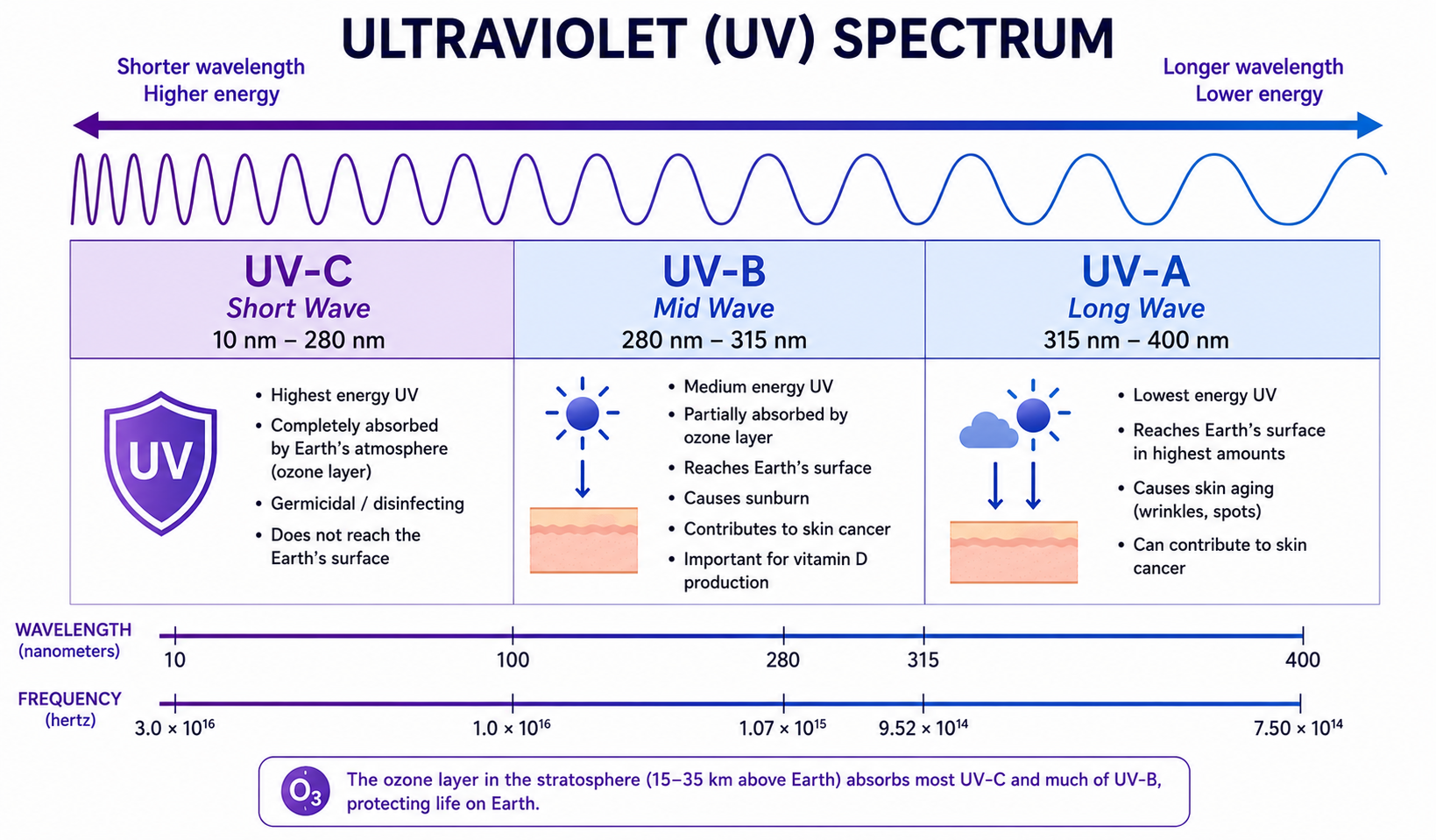
We divide the ultraviolet (UV) part of the EM spectrum into three broad categories. These help us define how much energy we’re dealing with and what precautions we need to take as a result.
Fluorescent mineral and glass collecting can be an awesome hobby, but like all hobbies, it comes with a few risks. The most prominent of these risks lie in the lights we use to induce fluorescence in our collections.
The three categories of UV light are known as UV-A (or “long wave” UV), UV-B (“mid wave” UV), and UV-C (“short wave” UV). While all three are now available in LED flashlight form for your collecting convenience, that’s a relatively new development - it used to be a lot harder to display your collections!
Long wave ultraviolet radiation, aka UV-A
UV-A, also known as long wave UV light, is the closest color to blue/violet light, just beyond the range of our human eyes. It’s the lowest energy of UV light and mostly comes from the Sun. In fact, about 95% of the light emitted by the Sun in the UV is UV-A light (at least by the time it reaches Earth’s surface). UV-A extends from about 315 nm to 400 nm (where blue light starts). It also is has the easiest time of all UV light getting from space to the surface of the Earth, even on a cloudy day!
Most new collectors start out with the cheapest UV flashlight available, a long wave UV flashlight around 395 nm. These are basically just purple light, but they work fine when it comes to making Uranium Glass and a few other materials fluoresce. These days, it’s common to progress next to a 365 nm UV flashlight, sometimes with a Woods Filter. These are still long wave UV lights, and so not very dangerous. Long-term exposure risks include faster skin aging (faster development of wrinkles and age spots), but long wave UV does not include ionizing radiation. However, some studies have pointed to a link between UV-A radiation and some kinds of skin cancer, so best to stay safe. Long wave UV flashlights are generally safe for kids getting into the hobby, just remind them not to stare directly into the light source itself or point it at themselves very often. Tanning beds, black light parties, and nail salons all employ exposure to long wave UV light, and are best if avoided for the sake of your skin (but hey, I also don’t go to the beach!).
How do you protect yourself from UV-A when using your long wave flashlight? You can get UV-blocking glasses (or if you have glasses or sunglasses, they might already block UV-A light), make sure to point them away from you while using them (especially away from your eyes), and display your minerals behind glass. Glass absorbs most UV light, which is why you don’t get a sunburn while sitting inside your car or house with the windows closed.
Mid wave ultraviolet radiation, aka UV-B
UV-B, also known as mid wave UV light, has more energy than UV-A light and begins to get into the ionizing radiation region. This means you want to limit your exposure to UV-B light, whether it’s coming from the Sun or another light source (like your flashlight). About 5% of the sunlight you are exposed to when you go outside on a sunny day consists of UV-B radiation. The Sun emits more than that, but most of it is blocked by our atmosphere (absorbed by a thin layer of O3 known as the ozone layer). This is the part of the sunlight that’s most dangerous to you and most likely to cause skin cancer when you get too much exposure. You can learn more about that at the American Cancer Society’s site here, where they usually distinguish between the types of UV light they are talking about, and the Environmental Protection Agency’s site here, where they do not distinguish between the types of UV light because they are referring to sunlight, a mix of UV-A and UV-B radiation.
Should you add a mid wave UV flashlight to your collection of light sources? I have one, and I really like it. There are a number of fluorescent materials that either don’t fluoresce or rarely fluoresce under 365 nm that can light up brightly under 310 nm (the typical UV LED wavelength in a UV-B flashlight). These include opal hyalite, Amazonite, Larimar, Kornerupine, and the red calcite that often surrounds Willemite in minerals from the Sterling Mines in New Jersey. However, because UV-B light is more likely to be ionizing than UV-A light, be more cautious when using these lights. Always point them away from your eyes and skin, and if using them to display mineral samples, put them behind glass. Glass absorbs most UV light but will let the visible fluorescence through for you to enjoy. But it’s not a toy! Don’t let the kids play with this one.
Mid-wave UV LED flashlights are still just starting to appear on the market. The wavelength of these is typically 310 nm, and they should be equipped with a Woods Filter, which will make them more expensive (expect to pay at least $60 or more in 2026 money). Be careful when ordering one, as many UV flashlights are advertised as mid-wave when they really aren’t. Look for a site that seems to know what it’s talking about and has pictures of the flashlight illuminating minerals.
Short wave ultraviolet radiation, aka UV-C
Many collectors jump straight from long wave to short wave without bothering with a mid wave UV light. In the old days (6+ years ago) a short wave UV light source was a mercury vapor lamp without the phosphorous layers you get with regular fluorescent lights. These lamps weren’t the safest or most stable things in the world. They need a lot of voltage to work, so that either meant you needed to plug them into a wall outlet or stuff them full of heavy D batteries. Mercury vapor lamps emit broad-spectrum UV-C light, including the wavelength we typically associate with short wave UV light (254 nm) but often also including higher energy radiation, including 185 nm light. 185 nm light interacts with the air to produce ozone, a toxic gas. Cheaper mercury vapor lights (many still on the market) didn’t include filters to absorb the 185 nm light before it got out of the lamp, so not only produced high energy radiation but also toxic fumes. Better-designed mercury vapor lamps come with filters to get rid of the ozone-causing 185 nm light, but these cost more.
However, the onset of the COVID epidemic drove the need for better, more efficient, and safer alternatives to mercury vapor lamps. Why? Because UV-C radiation at 254 nm and similar is ionizing radiation that damages DNA. While that’s not good for you, it’s great if you want to kill bacteria, fungi, and viruses, especially in the air and water supply. As a result, there are now more 254 nm UV LED flashlights on the market than there used to be.
Like UV-B flashlights and display lights, these are still expensive. The LEDs are more expensive to manufacture than visible and near-visible LEDs like those in long wave flashlights and have fewer applications on the market, and the flashlights need to include a Woods Filter. You can find them for sale online, but expect to pay at least $100 in 2026 money if not more for a good bright one. I got a Convoy brand online from StoneThroneDisplays (on Etsy and eBay), and it’s still working great years later.
UV-C is ionizing radiation, so like the UV-B light, this isn’t a toy. Don’t let kids play with it, don’t point it at your eyes, and don’t point it at your skin. Again, using it behind glass is a safe application - the fluorescence comes through, but not the UV-C radiation.
You may notice UV-C lights in public places like libraries and gyms, disinfecting the air around them. Isn’t that dangerous? Well, if you climbed up and stuck your face a few inches away from them, yes, they would be. Fortunately, UV-C radiation doesn’t make it very far through the air before it gets absorbed. So you’ll notice your UV-C lights are most effective when they are really close to your minerals (or really bright), and that UV-C doesn’t work from very far away. The Sun emits UV-C radiation, but it’s all absorbed by our atmosphere long before it reaches the ground.
A final note - high altitudes
I noted a few times that the atmosphere can absorb UV light. This means that the lower you are on the Earth’s surface (as in, around sea level), the more protection you have from the harmful effects of UV radiation. However, if you’re higher up - like on a mountain top or high altitude desert - you’ll be exposed to more UV light. This can cause conditions known as “sun blindness” in mountain climbers and people doing similar high-altitude sports and lead to migraines and other medical conditions. That’s why it’s extremely important to wear sunscreen and UV-blocking sunglasses and clothing while taking part in sports like these. It also applies at sea level when you’re exposed to a lot of reflected sunlight (say, off water or snow).