
The Science of Fluorescence
You might remember from middle or high school science that everything is made up of elements, and that the smallest piece of an element is an atom. Below on the left is a simplified version of a helium atom, consisting of two protons and two neutrons in the nucleus (center) and two electrons in the ground state (lowest energy level or orbital, closest to the atom).
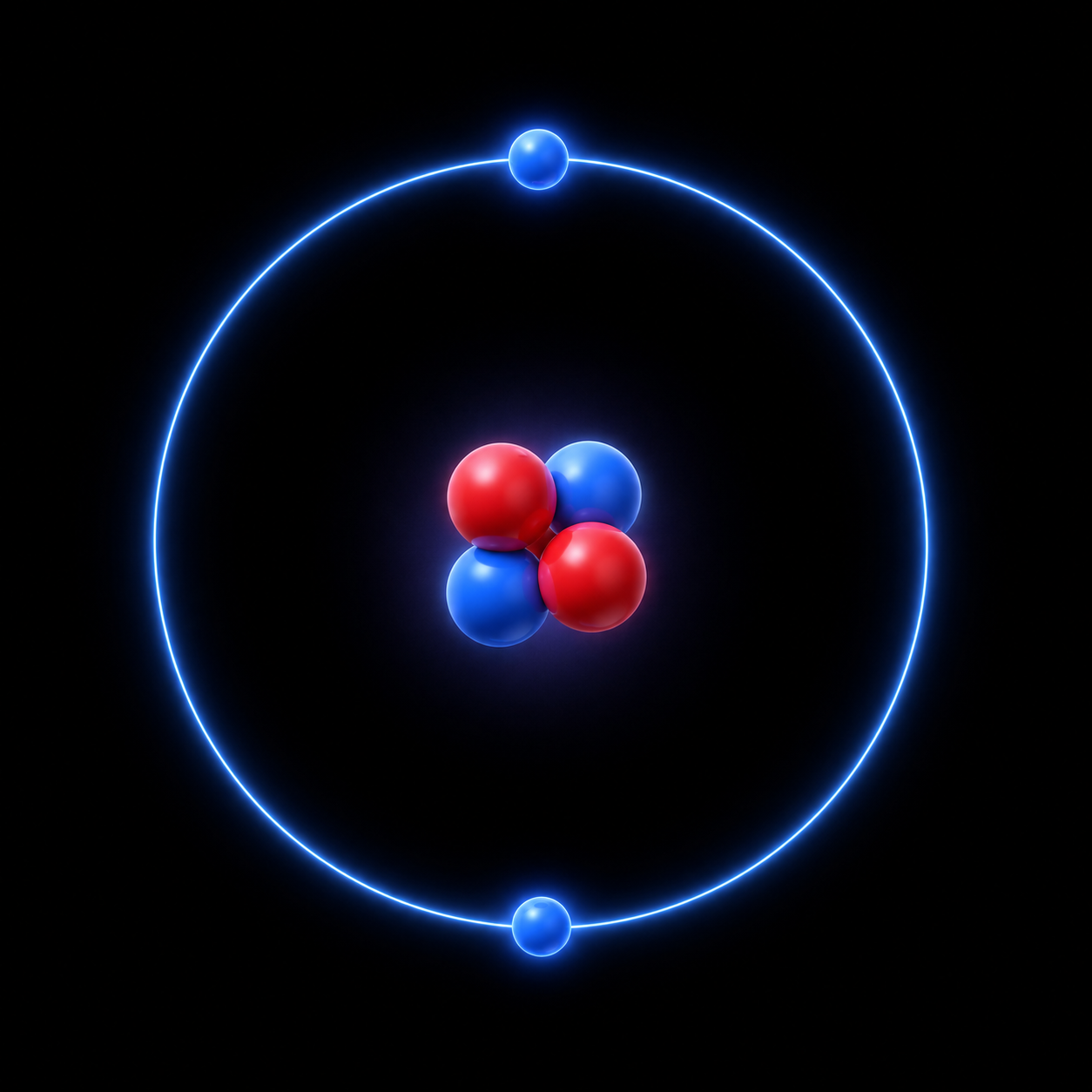
A helium atom with two electrons in the ground state (lowest energy level that goes around the atom).
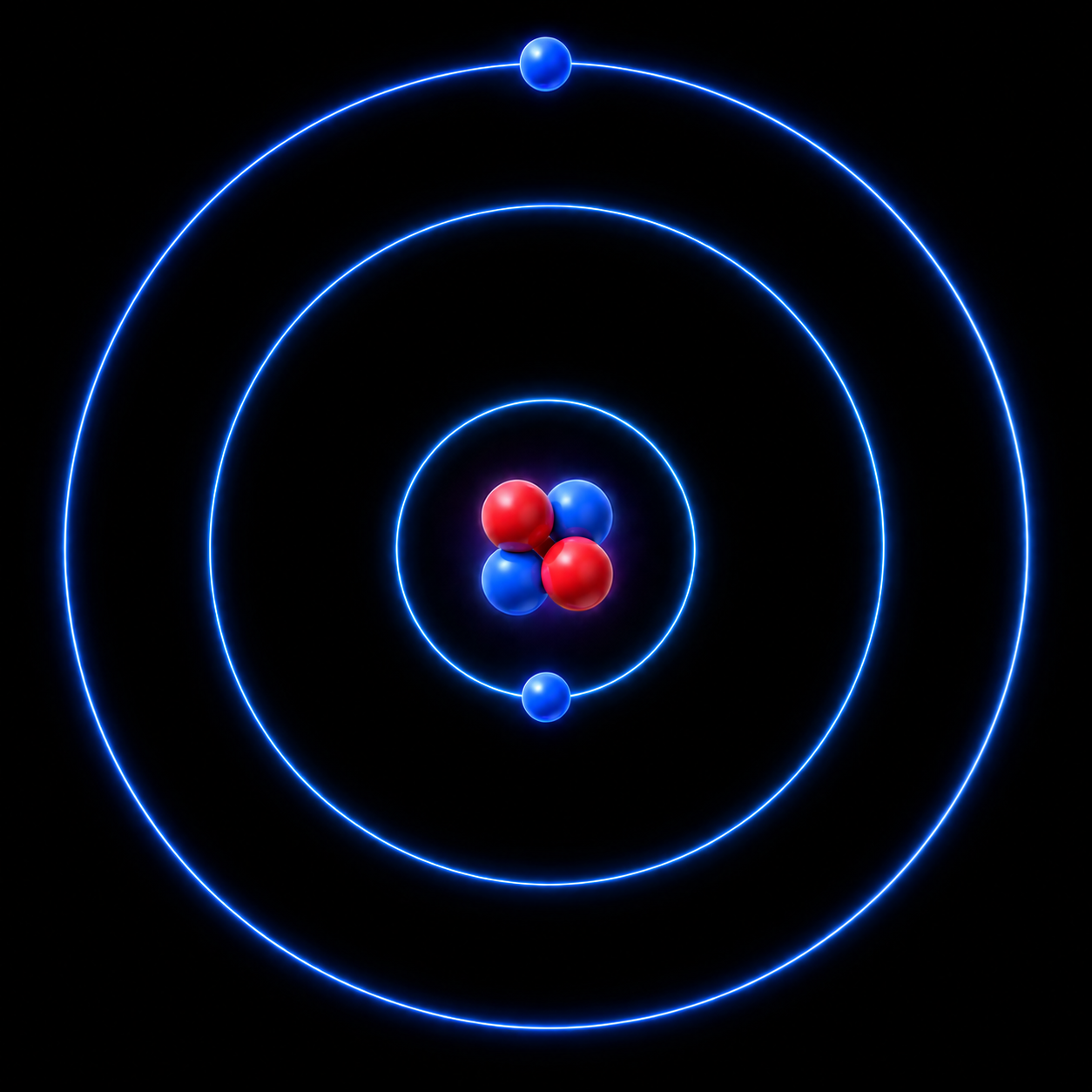
A helium atom with one electron in the ground state and one in an excited state (moved up two energy levels).
If an electron gains (just the right amount) of energy, it can jump up to a higher energy level, known as an excited state. One of the electrons in the atom on the right above absorbed enough energy to move up two energy levels to an excited state.
How does this work? Imagine you’re an electron, and the atom is a multi-story building. You’re on the first floor (lowest floor), and you want to move up to a higher floor in the building. The only way to do this is to take the elevator (you can only go down these stairs, not up). The elevator costs money. The higher you want to go in the building, the more you have to pay. Just like taking the elevator in the building, electrons have to “pay” to move to higher energy levels. But the electrons don’t use money - they use energy. To move to a higher level, they need to have energy.
This is a weird building - the floors aren’t all the same distance apart. The largest distance is from the first floor to the second, so that costs the most ($20). The third floor is closer to the second than the first was, so going from the second floor to the third costs $10. The fourth floor is closer again, so the trip from the third to fourth floor costs only $5. Just like the floors in this building, the energy levels in our atom get closer together the higher you go. The largest gap is between the lowest energy level (the ground state) and the first excited state, so that jump costs the most energy. The next jump from the first to second excited state is smaller, so it costs less energy, and so on as you get higher and higher in energy levels.
You’re ready to take your trip on the elevator from the lowest floor to the next floor up. But this elevator only takes exact change. The trip costs $20, and it will only take a $20 bill for the trip. It won’t take two $10 bills, or twenty $1 bills, and it won’t take a $100 bill and give you change. You need exact change for your trip. Just like the elevator, an electron moving to a different energy level needs the exact amount of energy required to get from one level to the next.
You get your money from the ATM. Where does the electron get it’s energy from? It gets it from light! As light shines on the atom, the electron can grab (absorb) some of that light for itself. But it can only absorb that light if it’s going to immediately spend it on a trip to a higher energy level (electrons don’t have pockets). Remember you need exact change for your trip, and the electron needs the exact right amount of energy to jump to a higher level. This means that the electron can’t absorb just any amount of light and save it up until it has enough - only a specific amount of energy will do, the amount required to move from the ground state to the first excited state, or from the ground state to the second level, and so on.
Remember that light carries energy. The longer the wavelength of the light (the “redder” the light is), the less energy it carries. For the electrons moving around in the atoms of a fluorescent mineral, they need a lot of energy to make those jumps - more energy than they can get from visible light. They need the higher energy that UV light gives them to start jumping to higher levels.
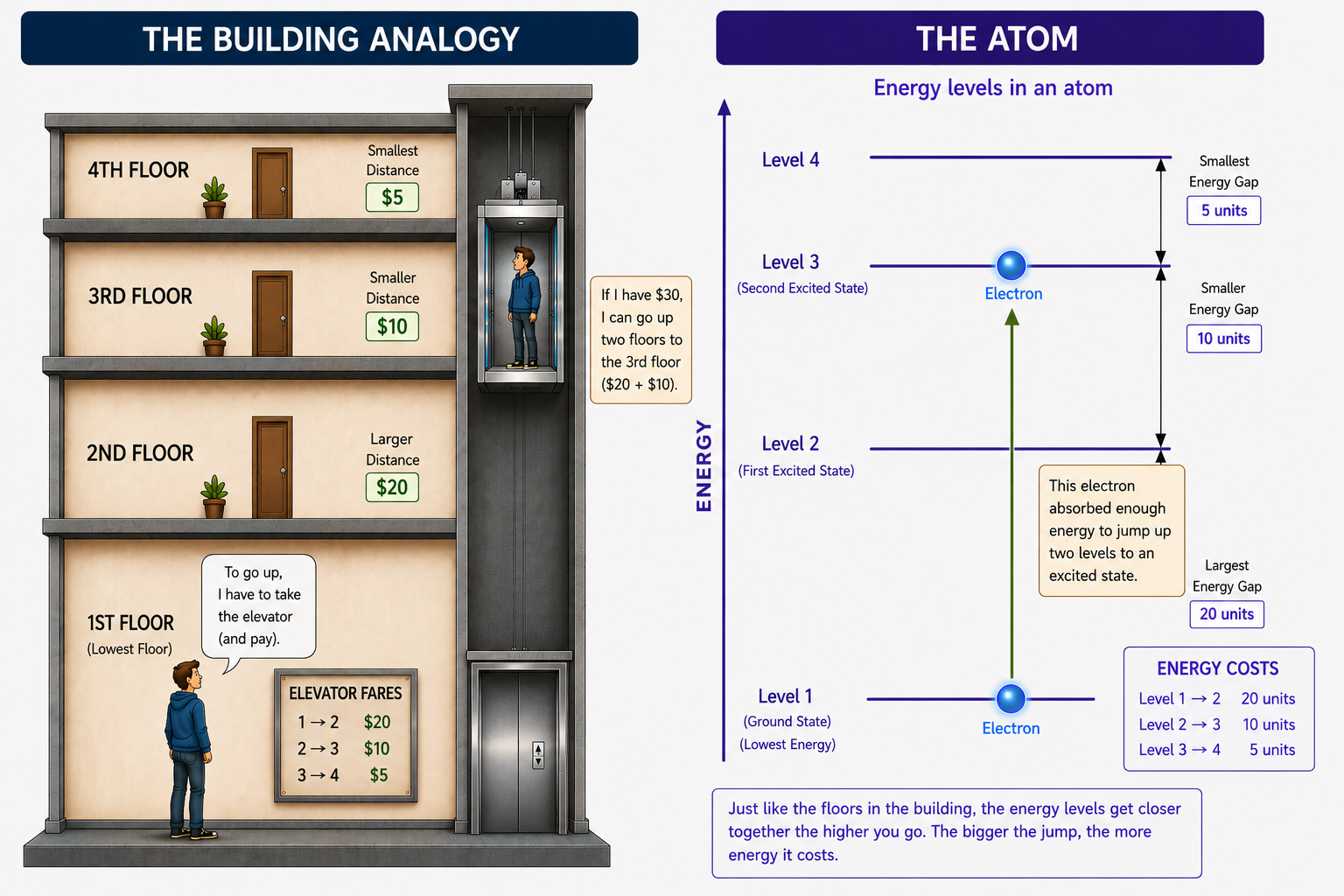
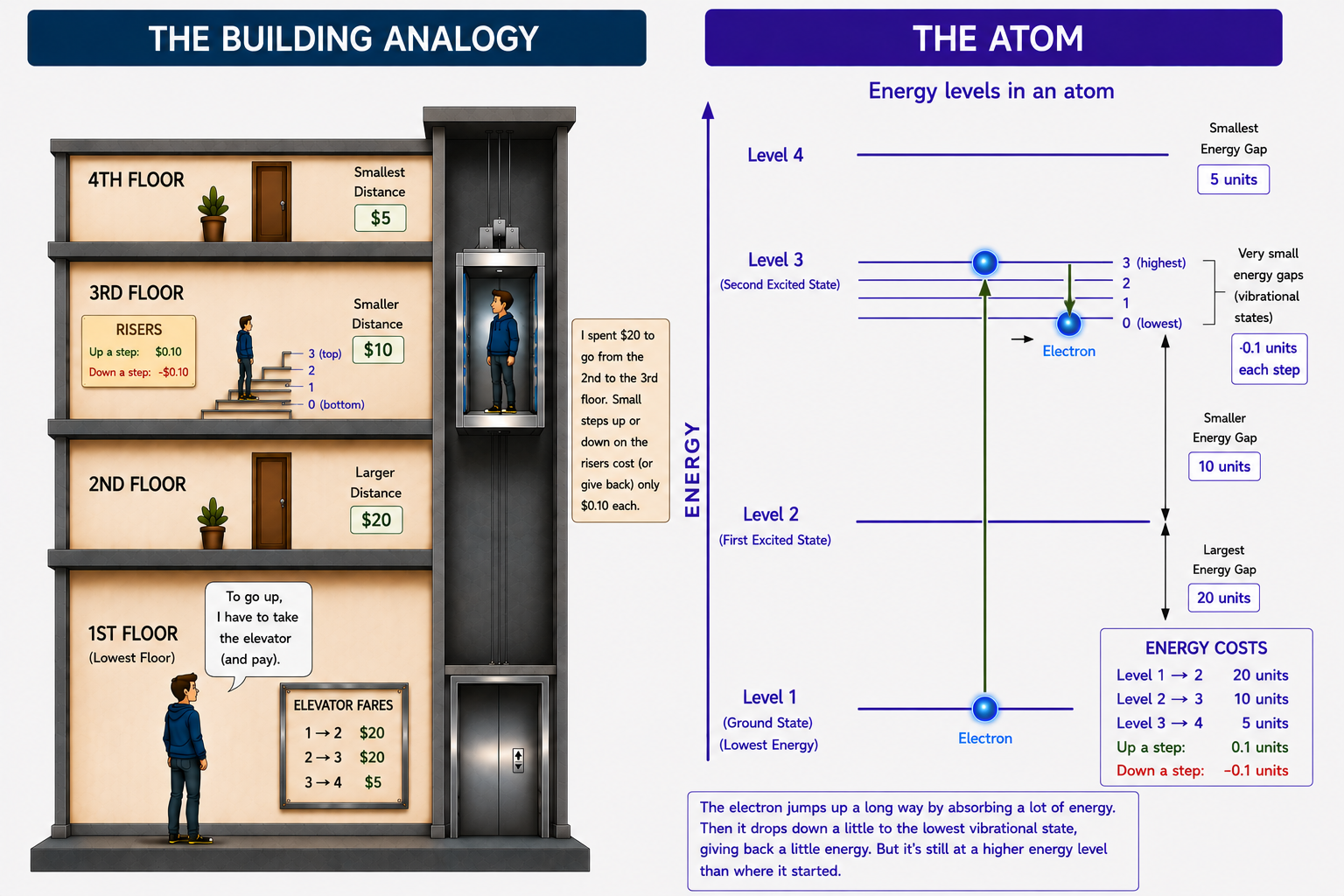
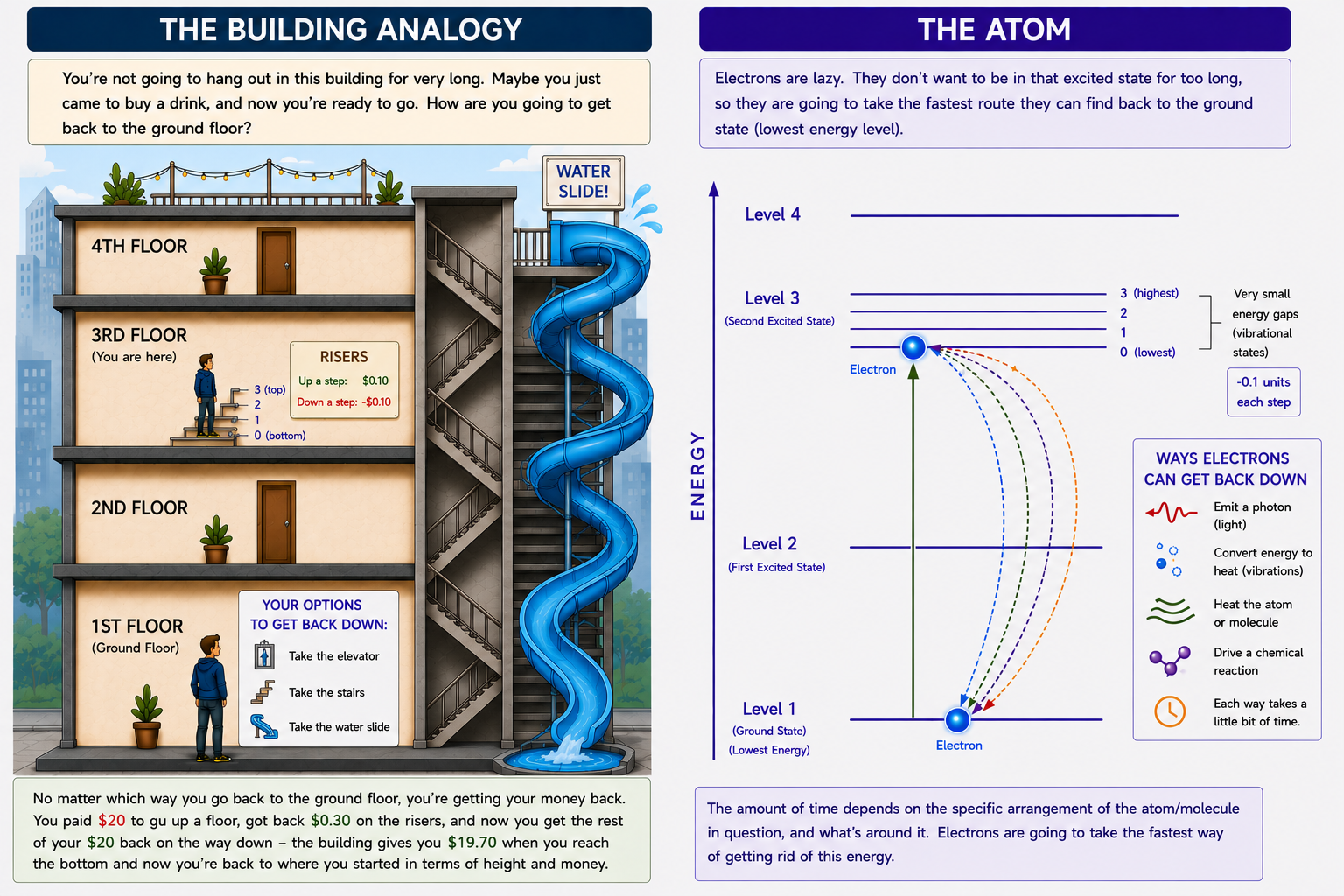
You’ve done it - you’ve moved to a higher energy level! Your exact change for the elevator got you up to the next floor. Now that you’re there, you see you have a few choices. There’s a set of risers. The elevator let you out somewhere on the risers - sometimes you’re higher up, sometimes you’re further down. It costs money to move up on the risers, but since it’s a very small distance (just a step instead of a whole elevator ride between floors), it doesn’t cost very much to move higher. Maybe a dime (10 cents) instead of $20. But if you want to move down the risers, you don’t pay money, you get given money instead. You gave up $20 to get to this floor, and now you want to move to the lowest position on that floor (bottom of the risers) and in the process, let’s say you moved down three steps and got given back 30 cents. You lost $20 and gained back $0.30, so now you’re at -$19.70.
The electron also encounters a set of smaller energy levels (steps) when it reaches a higher energy state. Each of those higher energy orbitals is actually a set of very close-together orbitals called vibrational states. Just like you, the electron doesn’t want to be at the top of these steps, so it immediately drops to the lowest of the vibrational states. This means it jumped up a long way (absorbing a lot of energy to get there) and then moved down a little bit (giving back a little bit of energy in the process). But it’s still got more energy than it started with, just like you paid a lot to move up and got back a little when you moved a little ways down.
One of the most important concepts in physics is the idea that energy is conserved. It’s not created or destroyed, it’s just moved around by changing from one form to another (such as chemical energy turning into electrical energy in a battery, or mass - in the form of wood - turning into thermal energy as it burns in a fire). When the electron loses a little bit of energy to move down to the lowest vibrational state, it gives up a little bit of energy. That energy goes back into the atom or molecule hosting the electron in the form of vibrational energy (the atom or molecule can jiggle around a bit more as a result).
Let’s say the electron originally absorbed a UV photon (light particle) from a 365 nm flashlight to move up from the ground state to the first excited state and a random vibrational state above the first excited state. Light particles with a wavelength of 365 nm each carry an energy of 3.40 eV (an eV, or electron-volt, is a way of keeping track of very, very tiny amounts of energy that would otherwise be a pain to write in other units). When the electron moved down to the lowest vibrational state, it gave up some of that energy in the process. Let’s say it gave up 0.9 eV. The atom or molecule absorbed that energy, and the electron is left with 3.40 eV - 0.9 eV = 2.5 eV.
You’re not going to hang out in this building for very long. Maybe you just came to buy a drink, and now you’re ready to go. How are you going to get back to the ground floor of the building? Now you’ve got a few options. You could take the elevator back down. You could take the stairs back down. There’s a water slide you could take. Which do you pick? It depends. How long do you have to wait for the elevator? Is it faster to take the stairs? Is the building on fire (in which case, take the stairs or the water slide)? Did you bring your swimsuit with you? Your choice depends on the circumstances. But no matter which way you go back to the ground floor, you’re getting your money back. You paid $20 to go up a floor, then got back $0.30 by going down the risers, and now you get the rest of your $20 back on the way back down - the building gives you $19.70 when you reach the bottom and now you’re back to where you started in terms of height and money.
Electrons are lazy. They don’t want to be in that excited state for too long, so they are going to take the fastest route they can find back to the ground state (lowest energy level). Just like you had a few options to get back to the ground floor, electrons have a number of ways they can get back to that bottom energy level. They could convert the rest of their energy to heat or vibrations of the atom or molecule like they did with the energy they lost going down to the lowest vibrational state. They could convert that energy to heating up the atom or molecule. They could use that energy to drive a chemical reaction. Or they could jump back down and emit a photon (light particle carrying the excess energy, in this case 2.5 eV). Each of these ways of getting rid of the energy takes a little bit of time to carry out. The amount of time depends on the specific arraignment of the atom/molecule in question, and what’s around it. Electrons are going to take the fastest way of getting rid of this energy.
In the case of fluorescent materials, the fastest way of getting rid of that energy is to emit it in the form of light (a photon). The electron emits a photon with energy 2.5 eV and ends up back in the ground state in the process. 2.5 eV is a smaller amount of energy than our original UV photon had - it corresponds to green light instead. So the electron absorbed a UV photon to move up to a higher energy state, lost a little bit by moving to the bottom of that higher energy state’s vibrational levels, and then emitted the rest of the energy it originally gained from the UV photon in the form of green light. That’s fluorescence!
There’s another way for the electron to emit light that’s a bit different from fluorescence. It works about the same way, it just takes longer. This is called phosphorescence.
How do you distinguish between the two? When you turn on a UV light, both fluorescent and phosphorescent materials immediately start to glow. When you turn off the UV light, fluorescent materials immediately stop emitting light, while phosphorescent materials will continue to glow for a while. Phosphorescence is also known as “glow in the dark”. Some minerals we call fluorescent are actually phosphorescent, like opals and strontium aluminate.