
365 nm or 395 nm UV lights - which is better?
Adria Updike, Ph.D.
First of all, what’s the difference? You can visit the Learn section of the website on the science of light, but the condensed answers are that (1) 365 nm light has slightly more energy than 395 nm light and (2) 365 nm light is a bit further from the visible light spectrum. That gives 365 nm two advantages over 395 nm.
Both 365 nm and 395 nm light falls into the UV-A part of the spectrum and are considered long wave UV. That makes them generally safe to use on a regular basis (extended exposure will increase skin aging with signs like wrinkles and age spots). With a slightly higher amount of energy per photon (the physics term for a particle of light), 365 nm is more likely to cause fluorescence in most fluorescent minerals than 395 nm. In some minerals that fluoresce under both 395 nm and 365 nm, you may see slightly different shades of light emitted under the two different wavelengths. Check out your sodalites (including Yooperlite) for a more orange/pink fluorescence under 395 nm and a more red/orange fluorescence under 365 nm.
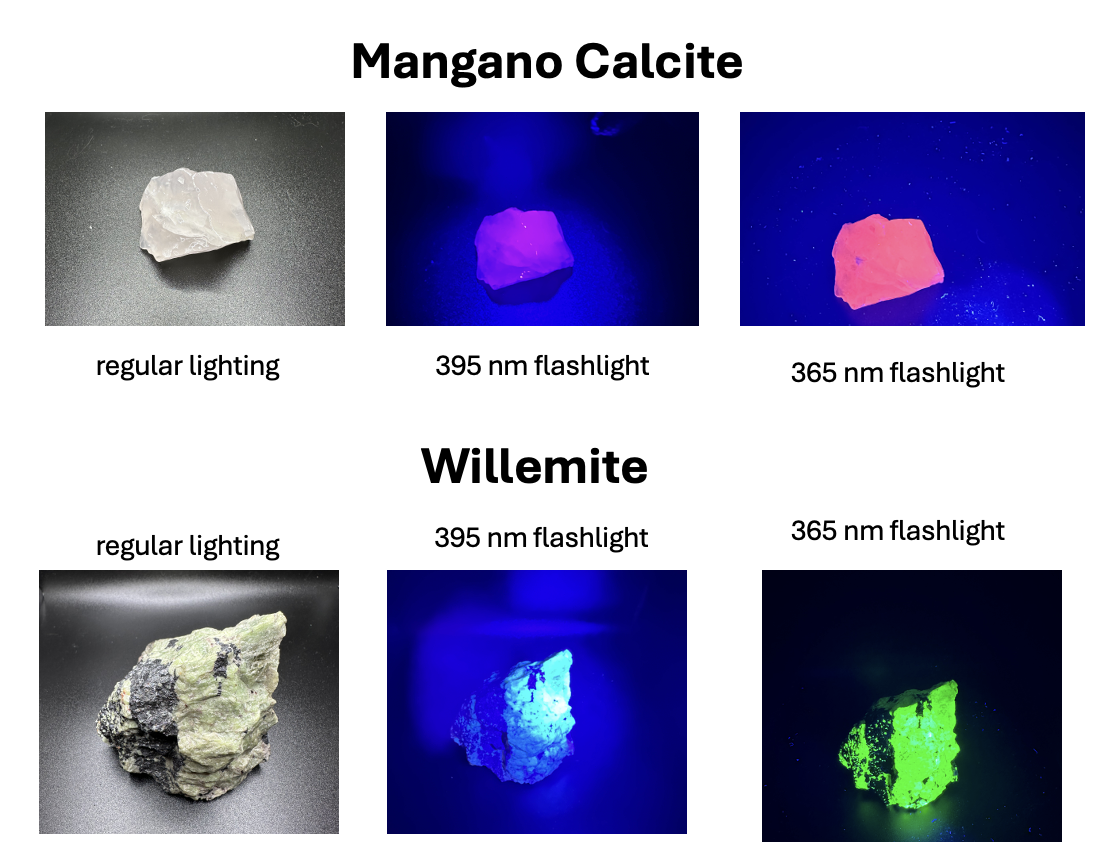
Let’s take a close look at advantage #1 above for the 365 nm flashlight. Some minerals need that extra bit of energy to show fluorescence at all. While Willemite, discovered in the zinc mines of northern New Jersey, is a famous bright fluorescer under short wave (making an impressive display when paired with the local calcite that fluoresces red under short wavelengths), it also lights up the same bright green under 365 nm - but not under 395 nm. In the image above, you’ll see Mangano Calcite looks similar under both wavelengths, while Willemite only glows green under 365 nm.
Now let’s look at advantage #2 for the 365 nm flashlight. Being further from the visible light spectrum (the visible light part fo the spectrum starts at wavelengths we can see with our human eyes, longer than 400 nm, violet light), the 365 nm LEDs emit less visible (blue/violet) light than the 395 nm LEDs, which nearly overlap with the edge of the visible spectrum. This means your images end up looking less blue than the images you take under 365 nm lights. Take a look at the Mangano Calcite images above - both the UV images were taken with LED flashlights with no additional filters applied. While both look blue in the background, the dim red fluorescence shows up much better in the 365 nm flashlight-illuminated image than the 395 nm, and that’s because there isn’t as much blue light coming from the flashlight itself for the fluorescence to compete with.
Why get a 395 nm flashlight at all? Two reasons. The first is that it’s cheaper - 395 nm LEDs have been on the market a lot longer than 365 nm LEDs, and 395 nm LEDs are cheaper to produce. One reason for that is that there simply aren’t nearly as many applications for the 365 nm LED as there are for the 395 nm LEDs. Common uses of UV flashlights include looking for urine stains, UV curing of resins (think your nail salon), tanning beds, and tire leaks (using fluorescent dyes). All those applications work just fine with 395 nm lights. The disinfection industry is driving the development of short wave UV LEDs (think COVID), but 365 nm doesn’t have nearly enough energy to disinfect anything.
The second reason you might want a 395 nm flashlight in your arsenal is uranium glass. Uranium glass is another popular collector item, and it fluoresces a bright green under 395 nm (and all other UV lights), making it easy to spot with a less expensive flashlight. Many people enter the fluorescent mineral hobby by starting with uranium glass, a common find at flea markets, antique stores, and estate sales. 395 nm flashlights have another advantage over 365 nm when it comes to collecting uranium glass - they don’t cause manganese glass to fluoresce as well. Manganese is a common addition to clear glass to make it clear in the first place, and produces a dimmer green fluorescence under 365 nm (nothing under 395 nm) making it easily confused with uranium glass for those just entering the hobby. So if you’re a glass collector looking for uranium glass specifically and can’t tell the difference between uranium green and manganese green yet (they’re really similar!), stick with the 395 nm light when glass hunting.
When you look for a good UV flashlight, you’ll soon notice that the more expensive models include something called a Wood’s filter. What’s that? Most UV LEDs, especially those close to the visible part of the spectrum (starting at 400 nm with violet light) also emit some visible light (which is how you can tell your flashlight is on). A Wood’s filter is designed to block visible light (wavelengths longer than 400 nm) and let through UV light (wavelengths shorter than 400 nm). This isn’t easy to do, and there aren’t a ton of applications for it, so the Wood’s filter is often the most expensive part of a good UV flashlight.
So why include a Wood’s filter? Fluorescence tends to be dim. The small amount of light emitted by your fluorescent mineral is competing with the small amount of visible light your flashlight emits that reflects off the mineral (and other surfaces), making the minerals look blue. This can often be confused with dim fluorescence, and it’s annoying. As you can see in the images above, my 395 nm flashlight doesn’t have a Wood’s filter, and as a result, any fluorescence emitted (and most of the rest of the image) look blue as a result. The Mangano Calcite was photographed under 365 nm light with a flashlight that doesn’t have a Wood’s filter (the less expensive DarkBeam model), and the Willemite was photographed under 365 nm light with a flashlight that does have a Wood’s filter (my UV Beast). Not just the mineral itself but the surroundings are much darker where the fluorescence isn’t emitted.
When do you need a Wood’s filter? You can put one on a 395 nm flashlight, but it’s often overkill for a flashlight that doesn’t light up much to begin with. You’ll find them on the better (and more expensive) UV flashlights emitting 365 nm light or shorter (including mid wave flashlights around 305 nm and short wave flashlights around 254 nm). Those LEDs also emit some visible light, and the Wood’s filter blocks it out for us.
So which flashlight do you want? It depends on what you want to look for and your budget. If you’re hunting uranium glass or cadmium glass and don’t want to get confused, get a 395 nm flashlight. If you’re looking for manganese glass or selenium glass, go for the 365 nm light. If you’re mineral hunting, get a 365 nm flashlight, and if you can afford it, get one with a Wood’s filter.
-Adria