
Fluorescent or Radioactive?
Types of Radiation
The two most common types of particles radioactive objects emit are called alpha and beta particles. We named them before we really knew what they were, so we didn’t call them what they actually are. Think back to basic chemistry. An atom (the smallest piece of an element such as copper or helium) consists of a nucleus (the center) containing protons (positively charged particles) and neutrons (particles with no charge). Around the center, electrons (negatively charged particles) orbit like tiny planets going around the Sun (at least in the simplified picture of an atom). Alpha particles are really the nucleus of a helium atom, containing two protons and two neutrons, and beta particles are electrons.
Alpha particles are the largest type of radiation. In fact, they’re so big that they’re easy to catch in a net. While they are still so tiny you can only see them with an electron microscope, they can be blocked by a piece of paper, fabric, or your skin. So while they are potentially harmful, when properly stored and handled they can’t do much to you unless you manage to swallow them or have a lot of them around. Uranium and Thorium are commonly-occurring, naturally radioactive elements that get incorporated into a number of fluorescent minerals, and emits alpha particles (and gamma rays).
Beta particles are smaller than alpha particles, making them harder to catch - they can go further (have more “penetrating power”). This makes them more dangerous, because a piece of paper won’t stop them - but a thin (3mm or thicker) sheet of aluminum or a thick (2 cm or more) sheet of acrylic or lucite will. While Uranium and Thorium themselves don’t emit beta particles, they decay into things things that do. Both Uranium and Thorium “decay” by emitting alpha particles, which change them into different types of elements. Eventually they turn into a stable form of lead, but on the way down to lead, they can turn into beta emitters.
Gamma particles, or gamma rays, are high energy forms of light. These are the smallest particles of radiation, and hardest to block as a result. A lead container is your best bet for relatively safe storage of these, but it’s probably best not to have minerals around that emit much gamma radiation.
Radioactive Minerals
Like all dangers, the dose matters. Small pieces stored inside thick-lined acrylic boxes in a display cabinet is much safer than a shelf next to your bed, and some minerals emit far less radiation than others. So which minerals are we talking about?
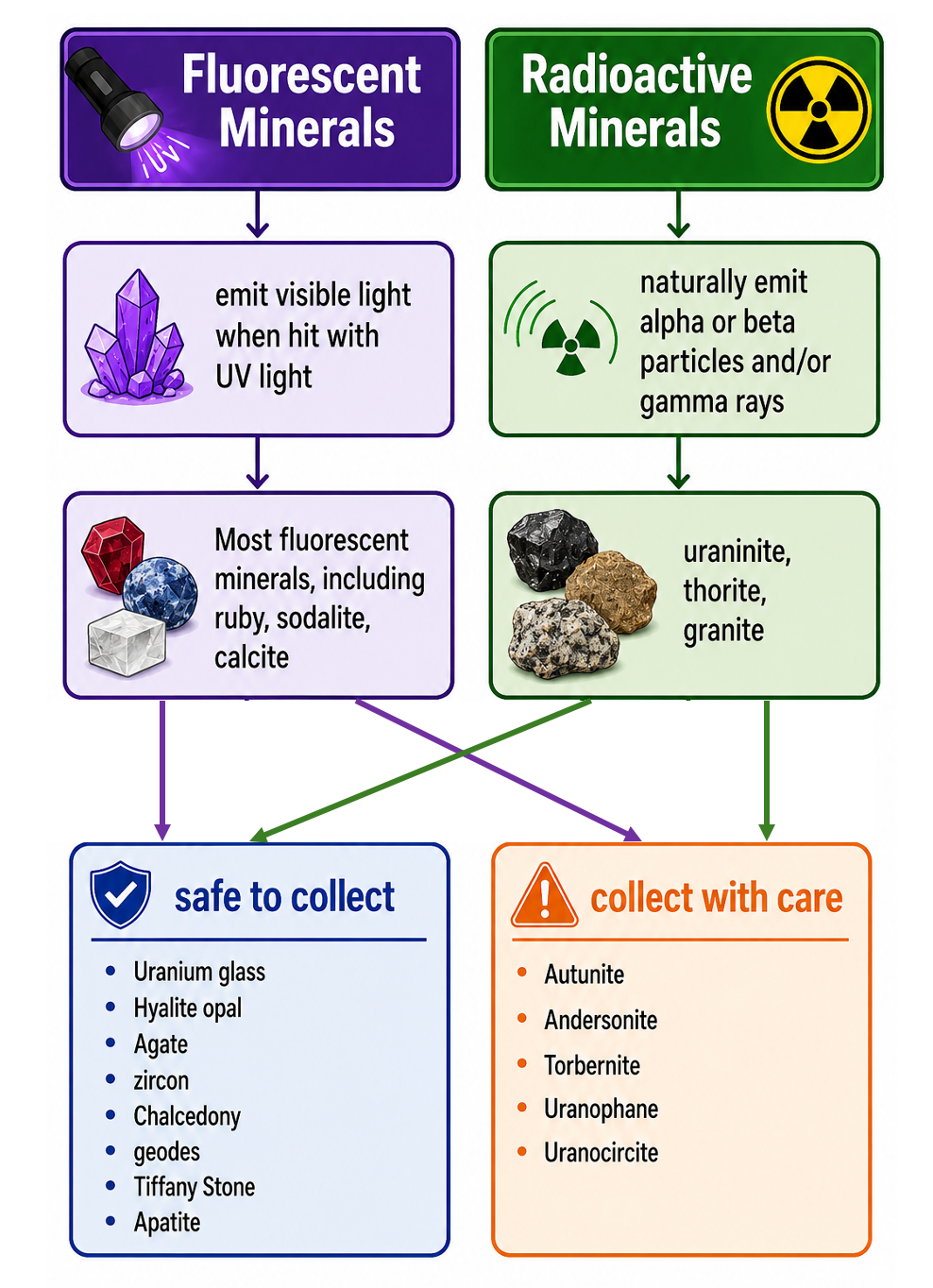
Most fluorescent minerals (including sodalite and it’s relatives Hauyne, Lapis Lazuli, Hackmanite, Afghanite, and Yooperlite), diamond, ruby, sapphire, quartz, Kunzite, spinel, kornerupine, amber, larimar, Amazonite, Dumortierite, fluorite, zoisite, Willemite, scapolite/Wernerite, calcite, and the man-made YAGs and strontium aluminate) do not contain any radioactive material (or enough to be measured by a simple Geiger Counter) and are perfectly safe to own and handle.
Some fluorescent minerals are also radioactive because they include small amounts (otherwise called “trace amounts”) of a radioactive material, usually Uranium and sometimes Thorium. The small amount they include isn’t enough to harm you, but it’s still a good idea not to sleep next to them. Putting them on display, handling them, and even making jewelry from them is considered safe. These include Opal Hyalite, some geodes, some forms of agate, Uranium Glass, zircon, Chalcedony, and Tiffany Stone (all of which can have trace amounts of uranium) and Apatite (which can include trace amounts of Thorium). The uranium is usually what makes these minerals fluoresce in the first place (the Thorium is not what makes Apatite fluorescent). Here’s an article from the EPA on collecting Uranium Glass, which has a similar radioactivity to these minerals (often more, actually): https://www.epa.gov/radtown/radioactivity-antiques .
And some fluorescent minerals are fluorescent because they include large amounts of Uranium, which makes them not safe to handle and they must be properly stored if you decide to own them. And again, don’t sleep or eat next to them. These include Autunite, Andersonite, Torberite, Uranophane, and Uranocircite. If you want to collect these, make sure you have proper storage for them (thick-walled acrylic boxes) and wash your hands after handling them. Also, try to find a very small piece for your collection - the larger the piece, the more radiation it will emit. I’m going to add radium to this list as well for the antique collectors reading this - paint containing should be sealed behind glass and stored inside glass or acrylic. Even small amounts of dust containing radium can be dangerous.
TL;DR
Worried you got something radioactive by mistake? Chances are good no one sold you something actually dangerous without your knowledge. The minerals that emit harmful amounts of radiation are expensive and you really need to seek them out. But you probably have things around your house that emit small amounts of radiation - everyone does! Did you know that bananas emit gamma rays? They include radioactive potassium - and so do you! It’s a very tiny amount and not anything you need to worry about, but it’s there. Granite countertops include small (but measurable!) amounts of Thorium. Radon gas can build up in your basement due to naturally-occurring Uranium in the soil decaying down to lead. Radiation is a natural part of life, and we encounter it every day. But given the choice, adding significantly to that amount we encounter isn’t a great idea.
-Adria
Or possibly both?
by Adria Updike, Ph.D.
What’s the difference between fluorescent and radioactive? Are some fluorescent rocks radioactive, and if so, do we need to worry about collecting them? Let’s start by defining both terms.
Fluorescent
Fluorescent materials absorb high energy light and emit low energy light in response. For our purposes, we’ll stick with saying minerals are fluorescent if they absorb UV light and emit visible light as a result. Since visible light is not a harmful form of radiation, fluorescent minerals are not considered radioactive under the normal usage of the word “radioactive” unless they also emit alpha, beta, and/or gamma particles, and most don’t.
Fluorescent minerals only emit visible light when they’re actively exposed to UV light. Radioactive minerals, on the other hand, always emit radiation regardless of whether or not UV light is hitting them (UV light doesn’t cause the radioactivity and doesn’t produce more of it either).
Radioactive
In physics, something that’s radioactive is emitting particles. And by particles, we can mean physical things (like electrons) and we can mean light (light particles are called photons). But that’s a very broad definition, and it includes things that are harmful and things that aren’t (you, for example, are emitting infrared light - in the form of heat - which technically makes you radioactive).
When we talk about something being radioactive as a bad thing, we mean that the object is emitting harmful radiation. That usually means it’s emitting particles that can harm you and/or light that can harm you. Some naturally-occurring materials, found all over the world, are incorporated into rocks and cause them to be radioactive - they emit those particles and/or light. Many of these minerals are very rare and require you to go seek them out, but others are common and many people don’t realize they own something radioactive.