
10 minerals that glow under UV light
Adria Updike, Ph.D.
4. Sodalite
Sodalite comes in many natural colors (including my favorite - deep green!) but the type of sodalite most often sold in rock shops is rarely fluorescent. It’s worth a look, but only some of the blue-and-gray mineral (often confused with lapis lazuli) includes the right amount of sulfur inclusions to produce the yellow / orange / pink (depending on the wavelength of light) glow you expect from a sodalite. Check it out, but don’t get your hopes up.
5. Amber
Amber is considered a gemstone, but isn’t a regular mineral, having formed from ancient tree sap. It’s a natural resin, and like most resins, it fluoresces a milky light blue color. From the pale yellow to the deep black, Amber is a reliable source of fluorescence.
6. Amazonite
Amazonite is really hit-or-miss. It tends to look its best under a midwave UV flashIight, so your 365 nm flashlight might not make it look like much. But sometimes you’ll find a piece that fluoresces under the 365 nm, anything from blue to red depending on the chemistry of the individual pieces.
7. Yooperlite
A form of sodalite first discovered along the shores of Lake Michigan in the 2000’s (there still stuff out there to discover!) and named after the residents of the Upper Peninsula of Michigan (“Yoopers”), Yooperlite is a form of sodalite that’s been now found in most states, usually along river beds. The unassuming gray rock (actually syenite) with black spots of sodalite that glow bright orange/yellow under 365 nm (pink/orange under 395 nm). Also known as Flame Stone or Emberlite, the amount of fluorescence can vary, so always check it out first. Not all shops include Yooperlite in the tumbled stone area, but if they have towers or carvings, you can sometimes find it in those sections.
8. Kunzite
A pale pink mineral that’s often transparent in gem form, kunzite glows a faint pink under UV light. You might have to stick it under a table to see the glow, as it’s not the easiest thing to spot in bright light, but it’s usually there!
9. Chalcedony
Chalcedony, opal hyalite, and the crystals inside some geodes all form under similar circumstances (from silica deposits left by water evaporating) and sometimes fluoresce green for the same reason - that water left behind some uranium when it evaporated. The amount of uranium in the water (and, as a result, in the crystal itself) is extremely tiny, but it doesn’t take much to make these crystals fluoresce a bright green. It’s certainly not a given, but worth a look! You may find a relative of it in the sphere section of the store under the name “volcano glass”.
10. Mangano Calcite
Calcite comes in many colors and forms, but the only form that fluoresces reliably is Mangano Calcite, a milky pale pink mineral. This one isn’t as common as many other, rarely fluorescent forms of calcite, but might be found in the tower or carvings area of a store. Look for the bright pink/red fluorescence it emits under 395 nm and 365 nm light!
11. Agate Slices
The previous ten are all naturally-occurring minerals that fluoresce due to their internal composition. However, if you’re checking everything in the store (worth a short!) you’ll find another common shop staple that fluoresces - bright pink agate slices. While agate itself can sometimes contain traces of uranium (and fluoresce green as a result) that’s not what you’re seeing here. Most agate come in “boring” shades of gray or brown, so they are often artificially dyed brighter colors, such as pink and blue. The pink dye used on agate slices is itself fluorescent, which makes the dyed agate slices fluoresce. How to spot a dyed mineral? The dyes tend to make the mineral look a more uniform color than you’d normally get with untreated stones, and the dye will collect along fractures in the stone, making the cracks glow more than the rest of the stone around it if the dye is fluorescent. You’ll often find a mineral called “strawberry quartz” or “cherry quartz” that’s really just dyed glass. “Blue obsidian” and “opalite” are other forms of glass often passed off as real minerals in shops.
Enjoy hunting! Check out our learning pages on fluorescent minerals to see these minerals look like under various wavelengths of light to start recognizing them for yourself.
-Adria
When new collectors ask “What should I look for?”, the first thing I say is “What are you looking with?” - because your tools make all the difference. If you’re going to go hunting for fluorescent minerals in your local rock shop, your best bet is a good 365 nm flashlight. Because stores are often well-lit, you want a bright one. I’ve always got a little DarkBeam 365 nm in my purse, and for direct sunlight, I carry a UV Beast 365 nm light. Just about everything interesting will fluoresce under 365 nm, even if it looks better under short wave. See the article “365 nm or 395 nm UV flashlight?” for why you might not want to bother with 395 nm when looking at minerals.
Now that you’re properly equipped, what should you be looking for? Here’s where to look - and what to avoid! - when searching for fluorescent crystals.
Fluorite
The original and one of the most reliable, fluorite was the first mineral that fluorescence was recognized in (hence the name of the effect). While it comes in a variety of colors, I’ve seen the best fluorescence (a deep blue) in the green and purple varieties of fluorite. You’ll often find fluorite tumbled, sometimes even carved. The relatively low price and range of natural colors make fluorite a common mineral found in many crystal shops.
Ruby
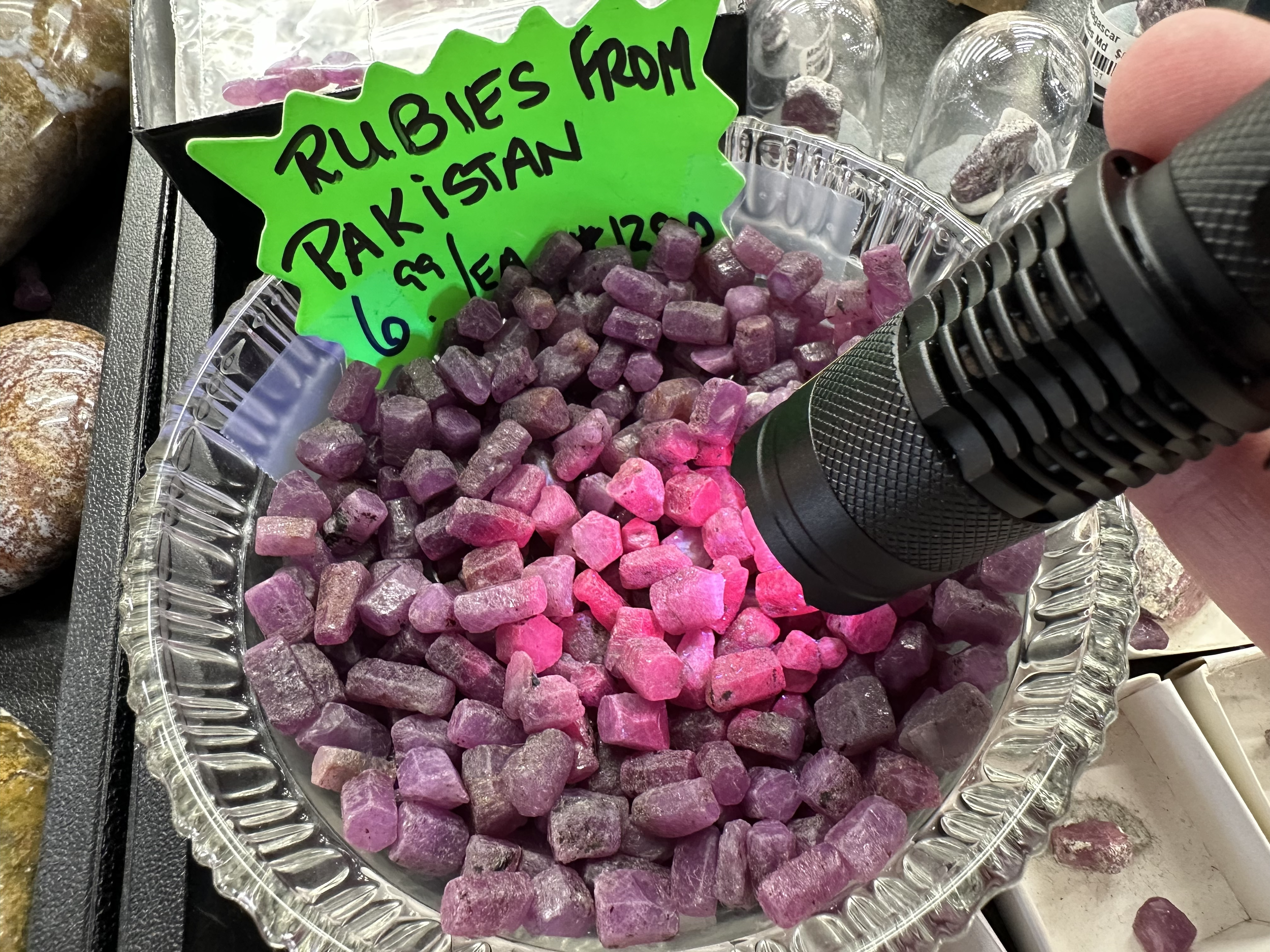
Wait, isn’t ruby expensive? It depends. A natural ruby with no inclusions (internal flaws) can be worth quite a bit, but we’ve known how to make lab-grown (synthetic) rubies for a long time. Additionally, ruby that isn’t gem quality isn’t uncommon, and is often found with other common minerals (look for Ruby Zoisite, Ruby Kyanite, and Ruby Fuchsite, all of which can have fluorescent red spots). It’s not uncommon to find relatively inexpensive synthetic ruby jewelry as well, especially at flea markets. And some rock shops carry rough ruby crystals as well, such as those in the picture on the right. Also called corundum, look for the bright red fluorescence under UV light.
Lapis Lazuli
When pointing you towards the fluorescent minerals in the store, most shop owners are surprised to learn that lapis lazuli can also fluoresce. Unlike ruby, where the entire gemstone emits red light, lapis lazuli fluoresces in spots of yellow. Lapis lazuli is known for its characteristic dark blue color, but is actually a mix of several stones. The yellow spots come from inclusions of sodalite, and you’ll also often find pyrite in samples. Watch out! Not all lapis is equally fluorescent. Always inspect pieces for maximum glow before purchasing.