
The Electromagnetic Spectrum (all about light)
Adria Updike, Ph.D.
The Electromagnetic (EM) Spectrum is the scientific term for all the forms of light. Normally when we think about light, we think about what we can see with our eyes - but that’s not the whole story! Our eyes are only sensitive to a very small portion of the entire spectrum. Most of the light in the universe is invisible to us!
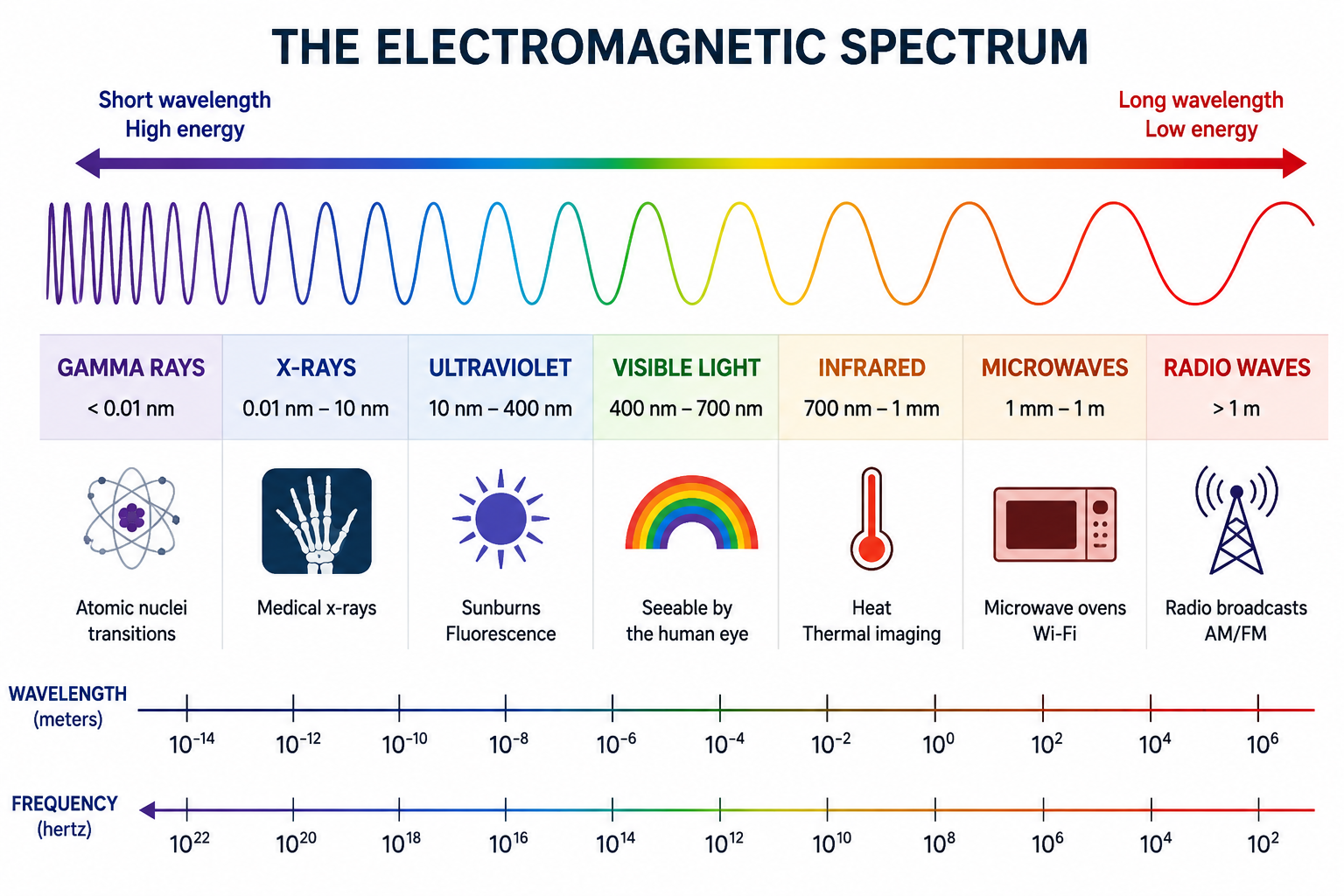
Above is a diagram of the EM spectrum. We represent light as a wave, one of the two ways of thinking about light (the other is as a particle). In the form of a wave, light has a wavelength (measured in meters, m), the distance between two crests of the wave, and a frequency (measured in Hertz, Hz), which is measured as the number of crests that pass you each second as a wave travels by. The energy carried by light is directly proportional to the frequency of the light. All types of light, no matter what their energy, frequency, or wavelength is, travel at the same speed - the speed of light, about 300,000,000 meters per second in a vacuum. That’s fast enough to circle the Earth’s equator more than twice each second!
The type of light carrying the lowest energy, the smallest frequency, and the longest wavelength are radio waves. It’s also the one that tends to confuse people - because isn’t radio sound, not light? A radio, the machine in your car, picks up light waves called radio waves with it’s antennae, then turns those light waves into sound waves for us to hear with our ears. So radio waves are light, not sound. You need a device to translate between them. And it’s not only your car radio that can do this - so can your TV, your cell phone, your computer, and many more! All internet devices work via radio waves, they just use different energies. Bluetooth, 4G, 5G, wifi - they’re all just different versions (energies, frequencies, wavelengths) of radio waves.
Microwaves are very similar to radio waves but with a slightly higher energy and shorter wavelength, and also used for communication purposes. In fact, not all fields of science make a distinction between microwaves and radio waves, and often just lump them together.
Infrared (IR) light has more energy than microwaves and radio waves, but less energy than visible light (the type we see with our eyes). However, we have other ways of picking up IR light - we perceive it as heat. When you sit outside in the sun, your skin gets hot because you’re absorbing IR light from the sun. The same thing happens when you stand next to a warm oven or fire. IR light can be dangerous in large quantities - we’ve all accidentally burned ourselves - but doesn’t cause radiation damage like some more energetic types of light.
Visible light, the portion of the EM spectrum we can see with human eyes, ranges from the lower energy red light (around 700 nm, or 0.000000700 m) to the higher energy blue light (around 400 nm, or 0.000000400 m). It’s actually a very small portion of the spectrum, but happens to be the part of the spectrum in which our sun emits the most light. Very bright like (like staring at the Sun) isn’t good for your eyes and can cause temporary (or permanent - just ask Galileo!) blindness, but won’t cause radiation damage.
Ultraviolet (UV) light is what you’d be able to see if you could see beyond the color blue/violet. UV light has a shorter wavelength, higher frequency, and more energy than visible light. We divide UV light into three types (see our article on Types of UV Light for more information), and the portion of the EM spectrum that causes radiation damage starts in UV part of the spectrum around 100 nm. Sunscreen, clothing, and hair can all help block this kind of radiation, so be sure to wear your sunscreen if you’re going to spend a lot if time outside! The Sun is the biggest contributor of UV light to the Earth, but you can also find it in UV flashlights, tanning beds, nail salons, industrial applications, and more.
X-rays are even more energetic than UV, meaning they can also cause radiation damage. We’ve found some useful ways to use them (like in x-ray imaging for medical applications) but we try to limit your exposure to them because they can also end up causing cancer in the long run. Natural sources of x-rays include the Sun (but most of the x-rays it sends to Earth are blocked by our atmosphere), the decay of radioactive materials found naturally on Earth, and lighting.
Gamma rays are the highest energy, shortest wavelength, highest-frequency type of light. Gamma rays are emitted in radioactive decay, by tiny particles from space hitting our upper atmosphere, and in extremely big cosmic explosions like gamma ray bursts (massive stars exploding at the end of their lives). Gamma rays. carry the most energy of all kinds of light, and as a result, are the most dangerous types to be exposed to when it comes to radiation damage.
Radiation Damage
Everyone is exposed to a natural background of gamma, x-ray, and UV radiation coming from the Sun, naturally radioactive minerals in the Earth around us, and particles coming from space. Organisms on Earth have evolved systems to adapt to the damage caused by radiation. These types of radiation are known as ionizing radiation because they carry enough energy to ionize (knock an electron off) an atom. This type of radiation is capable of damaging our DNA as a result. You might recall from high school science that DNA is the genetic code our body is constantly referencing to make new blood cells, grow new bone, and do other repair work in our cells. If the DNA strand is damaged, the body tries to replace it and fix it. It usually does a good job, but the more damage the DNA has, the harder it is to figure out what used to be there and replace it. The more ionizing radiation we are exposed to, the more damage our DNA undergoes, and the more mistakes can be made when fixing it. Mistakes can lead to growth in the wrong place or of the wrong type - cancer.
This is why we try to limit the amount of extra radiation we’re exposed to by not getting x-rays, mammograms, or CT scans from the doctor every day (a few times a year is usually fine). For the same reason, we want to limit our exposure to UV radiation. Wear sunscreen and cover-up clothing when you’re spending a lot of time outside, and don’t point your UV flashlights at yourself. Long wave UV flashlights, most commonly used in the fluorescent mineral and glass collecting hobbies, don’t do much damage besides causing eventual wrinkles. But mid-wave and short-wave UV flashlights can cause more damage, so limit your exposure to those by putting them behind glass and wearing eye protection for longer exposure. See our article on Types of UV Light for more information.